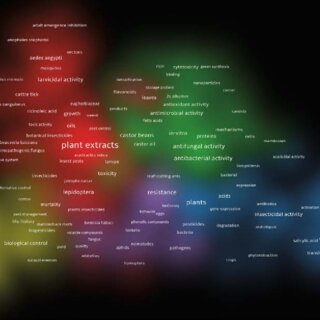
Objective: To analyze the scientifical production published in journals included in the Science Citation Index Expanded (SCIE) and Social Sciences Citation Index (SSCI) databases of the Core Collection of the Web of Science (WoS), using bibliometric indicators, with the aim of determining the dynamics, quality, structure, and emergent topics on the subject of Ricinus communis L., during the 2001-2022 period. Design/Methodology/Approach: The above-mentioned databases were subjected to an exploratory analysis to extract and evaluate bibliographical records, based on a search equation. The evolution of scientific production and the relationship between documents, authors, and key words were determined and characterized. In addition, relevant research topics and trends were identified. Finally, the VOSviewer software was used to develop one-dimensional (performance) and multidimensional (science mapping) indicators, based on records recovered from the databases. Results: The results were used to determine the dynamics of scientific production regarding the topic in question. The topic had an oscillatory behavior as time went by, increasing from 5 documents in 2001 to 25 documents in 2022. This increase showed the interest of scientists on the subject. The highest number of publications was recorded in 2014. Findings/Conclusions: The documents with the highest influence on the generation of new research addressed the use of R. communis as biocide, highlighting its harmlessness and environmental preservation. A similar behavior was reported with the use of R. communis extracts with larvicide, insecticide, acaricide, and antimicrobial activity. Regarding emerging research trends in R. communis, the most notable were in vitro studies, its association with nanotechnology; its antimicrobial, antioxidant, and acaricidal activity; and its use in combination with other plant species, as well as its use in metabolic or physiological studies.